Pauline Le Grand
Former intern at ICDS
In Ukraine and the Middle East, rapid advances in, for example, drones, AI‑enabled systems, and satellite capabilities are reshaping modern warfare. Europe must keep pace with this rapid technological change if it is to prevail in today's defence and security landscape. There has been progress, but some obstacles remain.
Despite recent progress, Europe remains dependent on non-European nations for its defence supply. Years of domestic underinvestment and fragmented procurement severely depleted military stocks and limited industrial surge capacity, constraining Europe’s autonomy and resilience.[1] A heavy reliance on global commercial markets leaves Europe dependent on others, for example, for the critical raw materials and semiconductors, necessary for key defence components. China produces 90% of the world’s rare-earth minerals and supplies 98% of EU imports.[2] At the product level, a deep dependence on the US for strategic enablers and capacities — such as missile defence, precision strike systems, and intelligence, surveillance, and reconnaissance — also creates vulnerabilities. This is especially concerning, as the shifting priorities and more transactional approach of the current administration have already led to supply delays.[3]
The EU has launched several initiatives to address these challenges and further accelerate European defence spending. In 2022, the Strategic Compass articulated a shared commitment to strengthen European security and defence.[4] In March 2025, the White Paper for European Defence set detailed objectives for boosting preparedness by 2030, including through disruptive innovation.[5] More practically, the EU has put financial instruments in place to assist Member States (MS) in developing their own defence capabilities.[6]
Understanding where Europe stands today is essential to assessing whether it can meet the 2030 timeline and, more broadly, assume greater responsibility for its own security. The EU has clearly identified military capability gaps, including air and missile defence, artillery systems, missiles and ammunition, drones and counter-drones, military mobility, strategic enablers, critical infrastructure, cyber, AI and electronic warfare.[7] The EU’s aim is to further develop defence systems in certain domains whilst also exploring new ones that may prove decisive in future warfare.
The EU countries are thus putting in place national, bilateral, multilateral, and EU projects. National ‘flagship’ projects are intended to demonstrate progress in European defence technology, notably in AI, cyber and quantum. There are initiatives in many European countries that already have strong defence research and development (R&D) capabilities. France, for example, has created a ministerial agency to supervise and coordinate defence-related AI projects.[8] It has also invested significantly in defence quantum technology, including by establishing a campus modelled on its Cyber Campus that aims to bring together start-ups, private companies, research organisations, and government departments.[9]
The scale and urgency of today’s R&D investment increasingly require European countries to work together. Germany and France, for example, have developed Joint Early Warning for a European Lookout (JEWEL), an early missile-warning project that would strengthen deterrence and reduce dependence on the US by ensuring European agency and sovereignty over real-time data and intelligence.[10]
Several EU structures and financial instruments have been implemented to enhance and promote technology development cooperation between MS. The European Defence Fund (EDF) co-finances collaborative research and technology (R&T) and R&D projects. It has a budget of nearly €8 bn for 2021–27, allocating €1 bn in its 2026 Annual Work Programme.[11] The EU Defence Innovation Scheme (EUDIS), meanwhile, has a budget of €1.5 bn through 2027, specifically to strengthen innovation, with €60 mn allocated to disruptive technologies in 2026.[12]
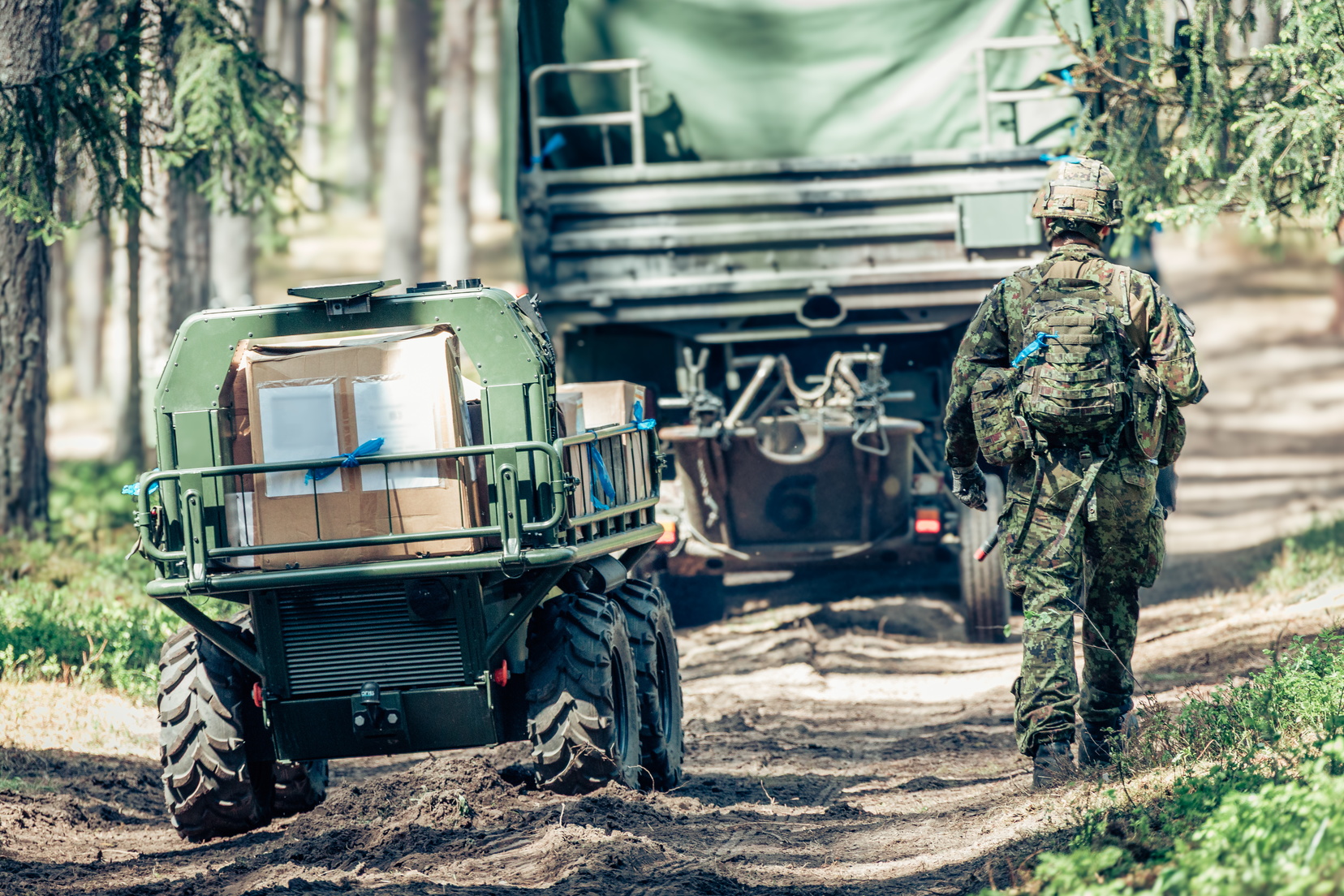
EDF financial support is offered primarily through grants and a bonus system that considers small and medium‑sized enterprises, and connection to a Permanent Structured Cooperation (PESCO) project.[13] PESCO itself has generated 83 projects between 2018 and 2025: 75 are still ongoing, 8 completed, and 11 newly launched.[14] They focus on key technologies including: drones (e.g., the modular unmanned-manned ground systems developed by Estonia’s Milrem Robotics); cyber (e.g., Estonia’s Cyber Ranges Federation, which seeks to integrate national cyber‑training infrastructures across Europe); multifunctional transceivers (e.g., the Finnish-led Arctic Command & Control Effector and Sensor System for situational awareness and resilience in the High North); and quantum (e.g., the Finnish-led QUEST project, focused on quantum technologies as strategic enablers for secure communications and sensing).[15]
The European Commission is also expanding its role in defence innovation through instruments that encourage MS to spend together. A €1.5 bn work programme under the European Defence Industry Programme (EDIP), which aims to strengthen and modernise Europe’s defence industry, was approved in March 2026.[16] Two-thirds of the total is earmarked for ramping up industrial production (€700 mn) and joint procurement (€240 mn), with the remaining funds allocated to development, innovation, and supply chain resilience. The European Defence Projects of Common Interest instrument, which focuses on five priority areas (drones and counter-drones, maritime and seabed defence, space, air and missile defence, and strengthening the eastern flank), will receive €325 mn to implement ambitious collaborative industrial projects, also open to Norway and Ukraine. €260 mn will be allocated to the EDIP’s Ukraine Support Instrument, to establish defence innovation routes under the BraveTechEU brand and benefit the Ukrainian and EU industries.
Additionally, in June 2026, the European Innovation Council Fund extended its funding mandate to include dual-use and defence-related technologies for investment opportunities worth over €1.4 bn.[17] This initiative was part of a legislative package aiming at boosting defence-related investment under the EU budget.
NATO’s Allied Command Transformation also helps Allies deepen collaboration on defence innovation, focusing on identifying innovative and effective solutions to address capability challenges arising from the NATO Defence Planning Process. A catalogue of innovative solutions across the Alliance was established in March 2026 for this purpose. NATO’s start-up accelerator, DIANA, created in 2021, also plays a central role in accelerating dual‑use technologies.
These significant initiatives demonstrate Europe’s willingness to cooperate in strengthening defence technology. Yet significant obstacles remain. Although European defence spending rose by nearly 20% in 2025,[18] this growth is uneven across the EU, depending on proximity to Russia: Poland and the Baltic states allocate 4% or more of GDP to defence, whereas larger western European economies spend proportionally less. At the EU level, the proposed draft for the next Multiannual Financial Framework (MFF) allocates five times as much to defence as in the previous framework (€131 bn); however, funding for the common agricultural policy is expected to be almost twice as much. When it comes to R&D, the EU consistently underspends compared to China and the US. In 2024, for example, China invested €893 bn in R&D, and the US invested €874.66 bn, while the 27 EU members spent less than half that — just €403 bn.[19]
Another obstacle is that European defence procurement systems struggle to keep pace with technological change, raising the question of how Europe can catch up in technology domains where it is already behind.[20]
The US’s technological dominance also stands in the way of Europe’s autonomy in this domain. The US is the leading supplier of advanced defence technologies and, since the EU is the leading destination for its defence exports, has little incentive to see Europe develop fully independent capabilities. For now, access matters more than origin. While key systems exist only in the US, Europeans inevitably buy American. But this dependence can become a vulnerability when strategic priorities diverge: first, on deliveries, which may result in capacity shortfalls, and second, on possible limitations on the use of weapons (as highlighted recently by concerns over access to the source code for the F-35’s software).[21]
Finally, ambitious and competing industrial interests, along with diverging strategic priorities, continue to undermine collective efforts within Europe. The June 2026 abandonment of the Future Combat Air System (FCAS), a joint programme involving France, Germany, and Spain, came as little surprise given the difficulties that France and Germany, and the two main industrial actors, Dassault and Airbus, have faced in reaching agreements.[22] But it illustrates how the need and desire for collaboration can unravel when political intent clashes with national interests.
Ultimately, this is the fundamental challenge posed by Europe’s fragmented defence landscape. National, bilateral, and European approaches each bring distinct advantages: national initiatives can move faster and respond to immediate operational needs; bilateral formats often allow deeper industrial or capability partnerships; and EU‑level programmes provide scale, funding and long‑term coherence. Europe needs all three, but it must find a better balance between them. Without a more coordinated articulation of these layers, promising initiatives will continue to collide with structural, economic and political barriers, slowing the continent’s ability to innovate, produce, and act.
The decisive factors now are speed and money. Capability development and technological innovation must advance far more rapidly, and a greater share of resources must be directed not only to acquiring systems but also to research, development, and scaling. The next EU long-term spending plan, the MFF, will be critical in determining whether Europe can sustain this effort. Supporting start-ups and continuing to prioritise dual‑use technologies will be essential to strengthen Europe’s innovation base. Cooperation with like‑minded European partners such as the UK, Norway, and Switzerland should be embedded in future EU instruments, while supply‑chain resilience will require deeper partnerships beyond Europe as well. The path ahead is demanding, but Europe has the momentum and must now convert it into lasting capability.
[1] Renaud Bellais and Daniel Fiott, “Security of Supply and Interdependency: A New Approach to Strategic Autonomy and Indispensability,” IRIS, 3 June 2026.
[2] Yuval Molina Obedman, “Europe’s $860 Billion Defense Plan Freezes out US Contractors,” Courthouse News Service, 16 October 2025.
[3] Paul McLeary, Stefanie Bolzen, and Chris Lunday, “Pentagon Likely to Cancel Missile Sale to Germany over Fears of Russia,” Politico, 4 June 2026.
[4] “A Strategic Compass for Security and Defence,” European External Action Service, 24 March 2022.
[5] European Commission, White Paper for European Defence. Readiness 2030 (European Commission, 19 March 2025), 14.
[6] “EU Defence in Numbers,” European Council, 7 January 2026.
[7] European Commission, White Paper.
[8] “AMIAD, Une Agence Clé Pour l’IA de Défense [AMIAD, A Key Agency for Defence AI],” Ministère des Armées, 2025.
[9] Alice Tidey, “France launches Defence Quantum Campus for military adoption,” Euractiv, 24 June 2026.
[10] John B. Sheldon, “Close the Gap: Turn the Franco-German Missile Early Warning into Measurable Capability,” Breaking Defense, 2 October 2025.
[11] “European Defence Fund (EDF),” European Commission, accessed in July 2026.
[12] “EU Defence Innovation Scheme (EUDIS),” European Commission, accessed in July 2026.
[13] European Commission, “European Defence Fund (EDF).”
[14] Maxime Cordet, “PESCO must step up,” ICDS, 7 March 2025; “EU agrees 11 more PESCO projects, looks to next phase,” European Commission, 27 May 2025.
[15] “IMUGS2 – Milrem,” Milrem, 20 January 2025; “Description of the Estonian PESCO project Cyber Ranges Federation (CRF),” European External Action Service, European Defence Agency, November 2021; “Description of the Finnish PESCO project Arctic Command & Control Effector and Sensor System (ACCESS),” European External Action Service, European Defence Agency, May 2023; “Finland to lead EU project on quantum technology for defence,” Ministry of Defence of Finland, 30 May 2025.
[16] “EDIP: Commission Adopts €1.5 Billion Work Programme to Boost European and Ukrainian Defence Industry,” European Commission, 2026.
[17] “The European Innovation Council opens to defence and dual-use technologies,” European Commission, 17 June 2026; “EIC 2026 work programme,” European Commission, 6 November 2025.
[18] European Defence Agency, Defence Data 2025-2026 (European Defence Agency, 16 July 2026), 6.
[19] Meghan Ostertag, “China Overtakes the United States in R&D Investment,” Information Technology and Innovation Foundation, 6 May 2026.
[20] “Europe’s Defence Industry at a Turning Point: Agility and Speed Take Centre Stage,” Consultancy.eu, 6 November 2025.
[21] “How America Can ‘Turn Off’ Denmark’s F-35s in a Clash for Greenland,” Military Watch Magazine, 20 January 2026.
[22] “SCAF : Tirer Les Leçons de l’Échec de l’Avion Franco-Allemand Du Futur [FCAS: Learning Lessons from the Failure of the Franco-German Aircraft of the Future],” Le Monde, 10 June 2026.
Disclaimer: The views and opinions contained in this paper are solely of its author(s) and do not necessarily represent the official position of the International Centre for Defence and Security or any other organisation.