Oleksandra Matviichuk
Head of the Center for Civil Liberties, Nobel Peace Laureate (2022)
This was the fourth winter of the full-scale invasion. And it was very difficult. Russian missiles and drones were deliberately destroying the energy infrastructure on which the survival of civilians depends. In January and February, temperatures dropped to minus 25 degrees Celsius. Ukrainian cities were literally freezing. Millions of people had limited or no access to heating, water, and electricity.
When the Russians first began striking the energy infrastructure, a photograph appeared online of a Kyiv schoolteacher. She was wearing a red winter jacket and a warm hat, standing on tiptoe beside a metal pole on which she had placed her computer—right outside, somewhere near a shop where a power generator was running and there was internet access. There, in the freezing cold, she was giving her students a lecture.
And I thought: the Russians came to take everything from us—our land, our freedom, our future, our children’s education. And this Kyiv schoolteacher decided to give them nothing. Even something as simple as teaching a lesson became an act of resistance.
I was in Kyiv when Russian forces tried to encircle the city. I refused to evacuate, and with part of my team, we continued our work on the ground. I remember that in the first days of the war, we celebrated every morning as a victory, because we managed to stand for another night. I remember how international organisations evacuated their personnel. At that time, not only Putin, but all western analysts were confident that Ukraine had no capacity to resist and that in three days, Kyiv would fall.
I mentioned this story for a reason. The Russians imagined the war as mathematics, so they assessed Ukraine exclusively from a quantitative perspective. The optics of Western societies were focused exclusively on institutions. Yet neither saw the human beings behind the numbers or ratings.
From my own experience, I know that when you cannot rely on the international system of peace and security, you can always rely on people. We are used to thinking in categories of states and intergovernmental organisations, but ordinary people have much more power than they even imagine. Ordinary people can do extraordinary things.
I don’t know how historians in the future will call this period. The world order, based on the UN Charter and international law, is collapsing before our eyes. It was created in the past century to protect people from wars and mass violence, but now it is stalling and reproducing ritualistic movements. Fires occur more and more frequently in different parts of the world because the international wiring is faulty and sparks are everywhere.
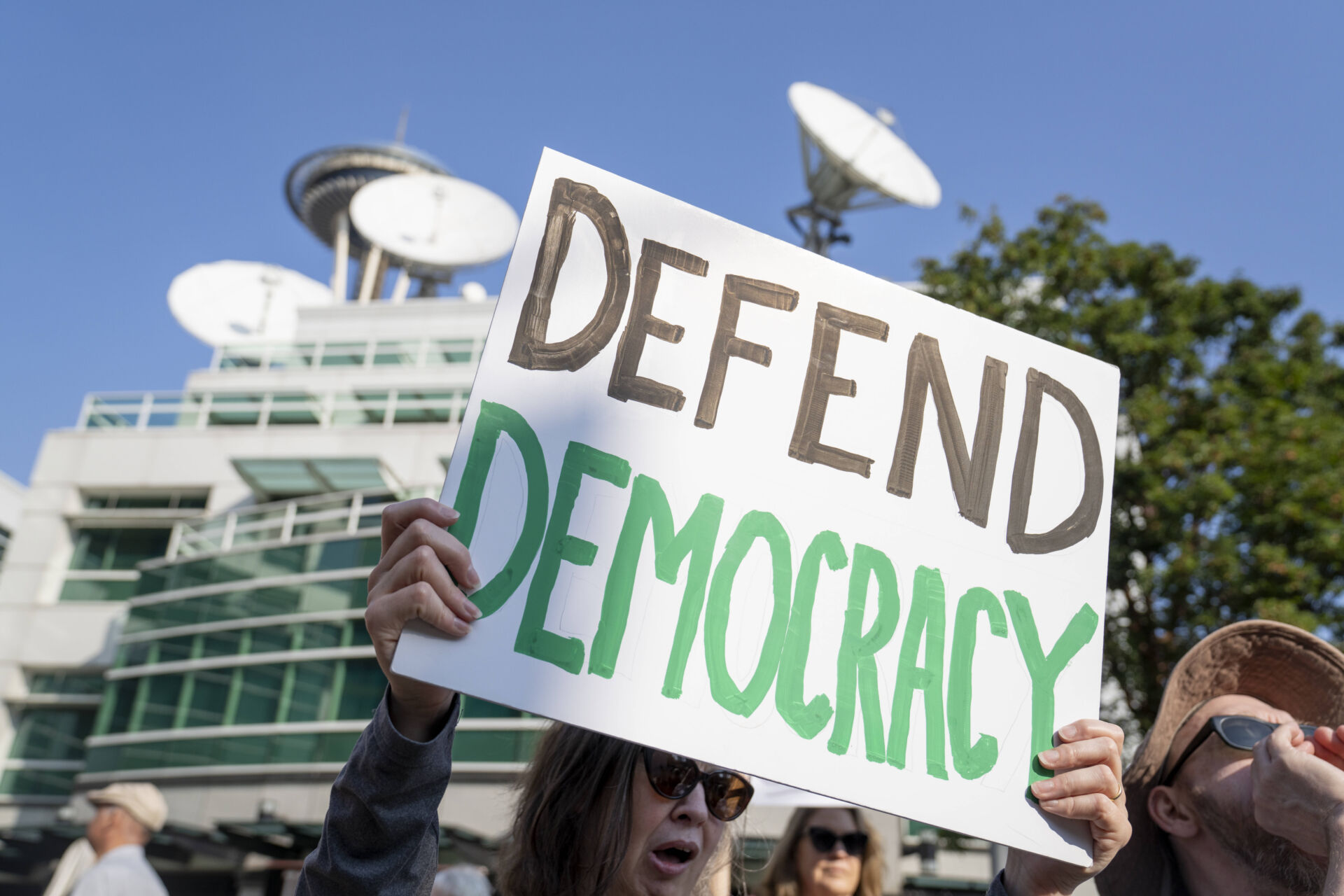
Ukraine has found itself at the epicentre of events that will shape the world’s future. It is not just a war between two states. It is a war between two systems: authoritarianism and democracy. Putin seeks to prove that democracy, the rule of law, freedom, and human rights are fake values because they no longer protect anyone. He wants to convince everyone that a country with a strong military potential and nuclear weapons can disrupt the world order, dictate its will to the global community, and even forcibly change internationally recognised borders. If Putin succeeds, it will encourage other authoritarian leaders in the world to do the same.
The international wiring is faulty and sparks are everywhere.
Putin launched a full-scale invasion not in order to occupy some more part of Ukrainian lands. Putin did it in order to occupy and destroy the whole of Ukraine and move further. He sees Ukraine as a bridge to Europe. His logic is historical. He dreams about his legacy. Russia is an empire. An empire has a centre, but no borders. Therefore, people in other European countries are safe only because Ukrainians are preventing the Russian army from advancing further.
A military technological revolution is taking place before our eyes. At the beginning of a full-scale invasion, the war took the form of a line of Russian tanks storming Kyiv. But now it is a war of unmanned systems, massive drone attacks, total transparency of the battlefield, and mass, cheap, precise long-range weapons. In several years, all the military experience of the 20th century will have become irrelevant. Ukraine is not a beneficiary of international support, but an integral part and a strong contributor to European security.
Modern authoritarian regimes do not share a common ideology. However, they promote common narratives. They argue that dictatorship means stability and security, while democracy means weakness and inefficiency. They combat humanistic ideas, such as human rights, independent courts, and freedom of the press. They erode trust between people and destroy our connection with reality.
On top of that, we live in a world where new technologies are rapidly developing. People spend more and more time in virtual spaces, polluted by fake news and disinformation. As a result, they lose the ability to distinguish between truth and lies. Now, the residents of a small community no longer have a shared picture of reality. Without a shared picture of reality, people are unable to act together. Without common action, how can we protect our democracy?
The Russian military committed terrible crimes in Chechnya, Moldova, Georgia, Syria, Mali, and Libya. They have never been punished for it. They believe they can do whatever they want.
If we want to prevent wars in future, we have to punish states and their leaders who start such wars in present. But in the whole history of humankind, we have only one precedent of punishment for the crime of aggression. It was the Nuremberg Trials where Nazi war criminals were prosecuted only after the regime had collapsed. But we are living in a new century. Justice should not depend on how and when the war ends. The global approach to crime against peace needs to be changed. We must establish a special tribunal now and hold Vladimir Putin, Aleksandr Lukashenko, and other war criminals accountable.
Justice should not depend on how and when the war ends.
Europe is less about geography than about the values of modern society. We live in a world where values have no national borders. Europe must defend freedom and democracy. It is the determination to act that gives a society a future.
Believe in Ukraine. Believe in Europe. We are not hostages of circumstances but participants in this historical process. Dignity gives us the strength to fight, even in unbearable circumstances.
This article was written for the Lennart Meri Conference special issue of ICDS Diplomaatia magazine. Views expressed in ICDS publications are those of the author(s).