Igor Gretskiy
Research Fellow
The Kremlin once again used an electoral event to demonstrate the stability of its political system; the Yabloko party was removed from the ballot to preclude even the hypothetical institutionalisation of discontent; and the Russian opposition in exile revealed its own helplessness.
Authoritarian regimes need elections to publicly affirm the legitimacy of their rule. But Russia’s leadership learned long ago that it is precisely at such junctures – when the population is mobilised on a mass political scale – that it becomes potentially vulnerable. A vote can expose cracks in the “power vertical” and set off splits among the elite. That is why the Kremlin pays especially close attention to controlling both the political landscape and the information space whenever an election approaches.
The 2026 campaign showed that amid active hostilities, economic stagnation, and ever-tightening international sanctions, the Kremlin’s grip over the electoral process only intensified. Spreading the vote across three days effectively ruled out any systematic independent monitoring of compliance with legal norms. Wherever alternative observation was nonetheless organised, the authorities did everything they could to obstruct it. But the single most important tool of control was the expansion of remote electronic voting into regions where support for United Russia had previously shown signs of eroding.
Resource disparities, too, remained enormous in United Russia’s favor, as they traditionally have been, from campaign budgets to media coverage. On television, debates retained only the appearance of genuine exchange, occasionally descending into outright parody and farce. In regional media, meanwhile, such debates were frequently called off simply because none of the announced participants showed up.
One of the key differences from the previous elections in 2021 was the unprecedented removal from the ballot of Yabloko, a party that had already been registered to run. Since the earliest days of the invasion, the party has campaigned under the slogan “for peace and freedom”, yet according to polling, its base of support remained marginal. Not only the Levada Centre and the Kremlin-aligned FOM, but even the polling service run by Yulia Navalnaya’s FBK, confirmed that as of April 2026, only 1.7% of Russians said they were prepared to vote for Yabloko.
Granted, the authorities had been pre-emptively and gradually weakening Yabloko ever since the 2024 presidential “election”. In July 2024, all of its candidates were denied registration for the municipal elections in St. Petersburg. In 2025, two deputy chairs of the party – Lev Shlosberg and Maksim Kruglov – were arrested, and by the spring of 2026 a wave of mass searches, detentions, and fines targeting Yabloko’s regional representatives was underway.
Some argue that Yabloko was removed because Russians had suddenly begun to change their attitude toward the war. The reality is more complicated than that. Among those Russians who favour ending the war, at least three broad cohorts can be identified. The first – a very small one – consists of people who believe invading Ukraine was a bad idea from the start. The second consists of those who support the “special military operation” in principle, but believe the Russian army has already seized enough Ukrainian territory and that further expansion will only grow costlier, making it more sensible to secure a ceasefire on Russia’s own terms. The third consists of those with no objection to any war of aggression, so long as it doesn’t directly affect them.
According to polling, since late spring the number of “anti-war Russians” has been growing specifically within this third cohort. Whereas in March 26% of Russians believed the country was headed in the wrong direction, by July that figure had climbed to 35%. The reasons are clear: the fighting has begun to erode everyday comforts people had grown used to. Russians have chafed increasingly at disruptions to mobile internet access and, more significantly still, at long lines at gas stations. According to polling, in August 55% of the population reported fuel shortages made their life more difficult.
To keep these three groups from converging around a single point, Yabloko was pulled from the ballot. Some of these voters went on to back New People, a party that supports the invasion of Ukraine but favours a free internet. Others backed the Communist Party, reasoning that the Communists were the only force with any real shot at beating United Russia. And some simply stayed home. This – the dispersal, demobilisation, and demoralisation of the discontented – was exactly what the Kremlin wanted.
Notably, Kremlin political strategists made no attempt to channel public discontent toward the systemic parties or Kremlin-controlled spoiler parties. Apart from Yabloko, not one of the ten other registered parties featured any kind of pro-peace message in its platform. And had the gap between voting day and the start of Ukraine’s 40-day effort to pressure Russia into peace been a month shorter, the Kremlin might have faced far greater difficulty staging the “election” according to script.
The Kremlin was not the only one preparing for the election well in advance. So was the Russian opposition in exile. Yulia Navalnaya and her FBK, for instance, launched their own campaign in September 2025. Yet no clear, unified tactic was articulated until the end of July 2026. Tellingly, rather than working one out, the opposition in exile spent most of that time engaged in its familiar, abstract debates over what a post-Putin Russia might look like and how democratic reforms might be carried out.
When Russia’s Central Election Commission announced Yabloko’s registration, and the party’s ratings began to climb, many opposition figures in exile called on Russians to vote for it and even announced the creation of a “Public Support Hub for Yabloko”.
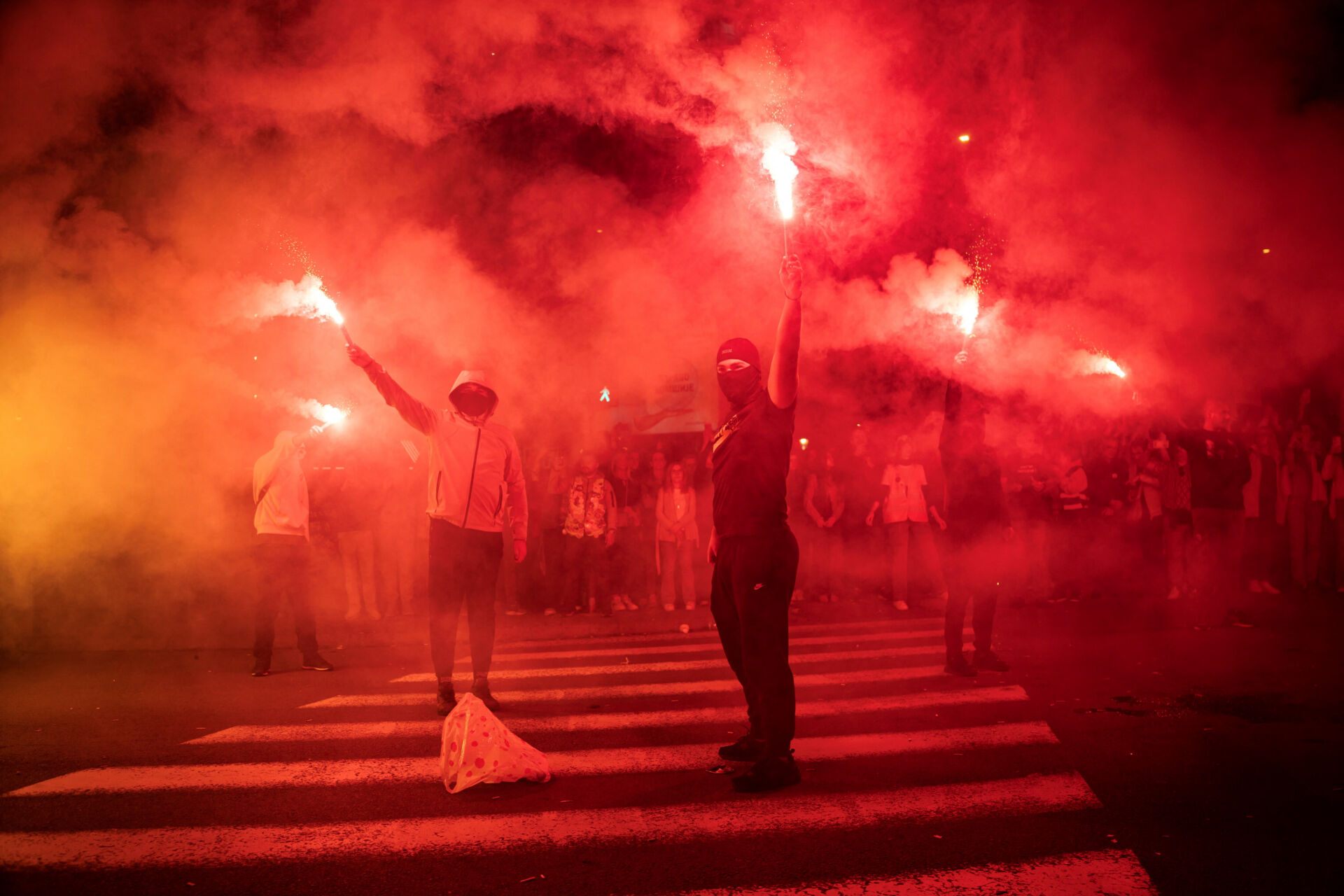
Within days, however, after Yabloko was removed from the ballot, the ad hoc coalition of Russian political émigrés that had formed around supporting it instantly fell apart, giving way to a cacophony of conflicting recommendations on what position to take toward the vote. Many opted to back any party but United Russia, even while recognizing that the results would not be fair. Others, like Garry Kasparov and the Free Russia Forum he leads, categorically opposed any participation in the vote on the grounds that the “election” was being held partly on Ukrainian territory occupied by Russia. The impression of the opposition’s helplessness was reinforced by reports from outside Russian diplomatic missions on the eve of the vote, where Russian emigrant politicians held rallies. Those organised by Ilya Yashin in New York and Ivan Zhdanov in Warsaw drew only about 100 and 80 people, respectively, while in Berlin, the hub of the new Russian political emigration, an anti-war rally attracted just 50.
On the whole, the September “election” showed that the Russian opposition in exile is incapable of formulating and sustaining a coherent long-term strategy. It does not create political opportunities for itself; rather, those opportunities are generated, to a far greater extent, by the successful actions of Ukraine’s armed forces. It is no coincidence, for instance, that the growing appetite this summer among the Russian population for an end to the fighting is directly tied to the long lines now snaking outside Russian gas stations. In other words, the opposition owes its brief moment of consolidation around Yabloko to the Ukrainian military and its devastating strikes on Russian oil refineries. The lesson seems obvious: it ought to be publicly supporting assistance to the Ukrainian army as visibly as it possibly can. Instead, for nearly five years now, the overwhelming majority of it is still clinging to the doomed hope that it might somehow outmanoeuvre the Kremlin at its own game.
Views expressed in ICDS publications are those of the author(s).