Tetiana Fedosiuk
Publication Manager / Editor of Diplomaatia
Dr Joris Van Bladel cautions against the dangers of projection, premature conclusions, and oversimplifications in analysing Russia.
As the saying goes, Russia is never as strong or weak as she looks. What are the foundations of the Russian endurance, and how has being the “land of great sacrifices” shaped Russian strategic culture?
Dr Joris Van Bladel: Indeed, in this war of attrition, it is a very unsatisfying idea—or reality—that Russia is neither stronger than nor weaker than we think. Russia is a strategic problem for an analyst trying to assess the ‘home front’ and the economy amid what we call a ‘total war.’ Determining precisely where the regime and Mr Putin will have to change the objectives of this war of attrition is a nearly impossible intellectual exercise.
Therefore, I work a lot on methodology. First, how to penetrate a country in order to gain knowledge if one does not have physical access. And the regime wants to keep it this way, as it plays into its hands. Second, how to see beneath the facade of normalcy that the regime wants to maintain. Although we know that there are structural problems, how far-reaching are they?
I have my severe reservations against announcing—prematurely—the end of Mr Putin and his regime, a dissolution of Russia or its economic collapse, etc. We have been proven wrong time after time. Nevertheless, a certain point will come, and we will be surprised by how quickly the system can unravel. But until then, we need prudence, distance, and realism.
The adversary is, indeed, taking pride in its so-called ‘endurance’—a narrative that feeds Russian self-perception of superiority and that is being imposed on us. Although it is often far from reality, it is an important element, nonetheless. Take one variable: i.e., the number of Russians killed in action, which is roughly over 300 000 people. From a humane point of view, this is tragic. The regime, however, is proud of this number as a ‘sacrifice’, believing it makes Russia superior, especially against Europe. Russians believe we, Europeans, are no longer capable of such a sacrifice. They know us rather well, and there is an element of truth to it: we cannot die anymore.
We should not oversimplify this. It is a historical cliché: eight million Soviet soldiers killed during the Second World War, so Russians can die now, too. Nor should we project our own cultural views and social mentality onto Russia, because it is different. Not that the Russians as humans are different, but the regime is different, and we must see it for its brutality.

Where is that Russian breaking point, after which change is possible?
The economic situation is crucial to watch, as it affects ‘normal’ daily life in Russia. Hence, inflation rates are more important than the number of people killed in Ukraine. Why do people support Putin? Besides the purely nationalistic and conservative rhetoric, it is a form of stability that he provides. Generals are important for the war, but the governor of Russia’s Central Bank is the secret weapon. Elvira Nabiullina is a very competent person, and one should not underestimate her. But there are limits. It is a downturn in the economy, not the war, that can trigger change. If the economic situation changes fundamentally, people will react. We should also be watching the elites and the combat veterans. When all these elements collide and reach a climax, changes will begin unfolding rapidly.
Inflation rates are more important than the number of people killed in Ukraine.
The problem is that there is no organised opposition in Russia. Approximately 10% to 15% of people oppose Putin’s policies. Their exact percentage is less important than their level of organisation as a group—and we do not see it. Even the opposition outside Russia has struggled to organise and ‘unite against’, let alone to project a ‘campaign for’ inside Russia.
On the one hand, Russian society has become heavily militarised; it worships war and sacrifice for the Motherland, which has become a new state religion of sorts. On the other hand, the regime chose not to declare war, still shying away from the term. If war is such a central, organising element, why does the regime still call it a “special military operation” and avoid total mobilisation?
First of all, what we saw when this war began—unlike now—was the result of a Russian strategic failure. The “special military operation” failed to break through the Ukrainian defences. What the Ukrainians have achieved is that they have pushed the Russians into defence, into a war of attrition.
But Russians have adapted. And so has their rhetoric. If their original plan had succeeded, it would not have been necessary to change the main narrative or militarise the economy and society. Putin still believes he can manage the situation and, therefore, continues to use the old rhetoric referring to the Second World War, the defence of the Motherland, and claiming that Russia was attacked.
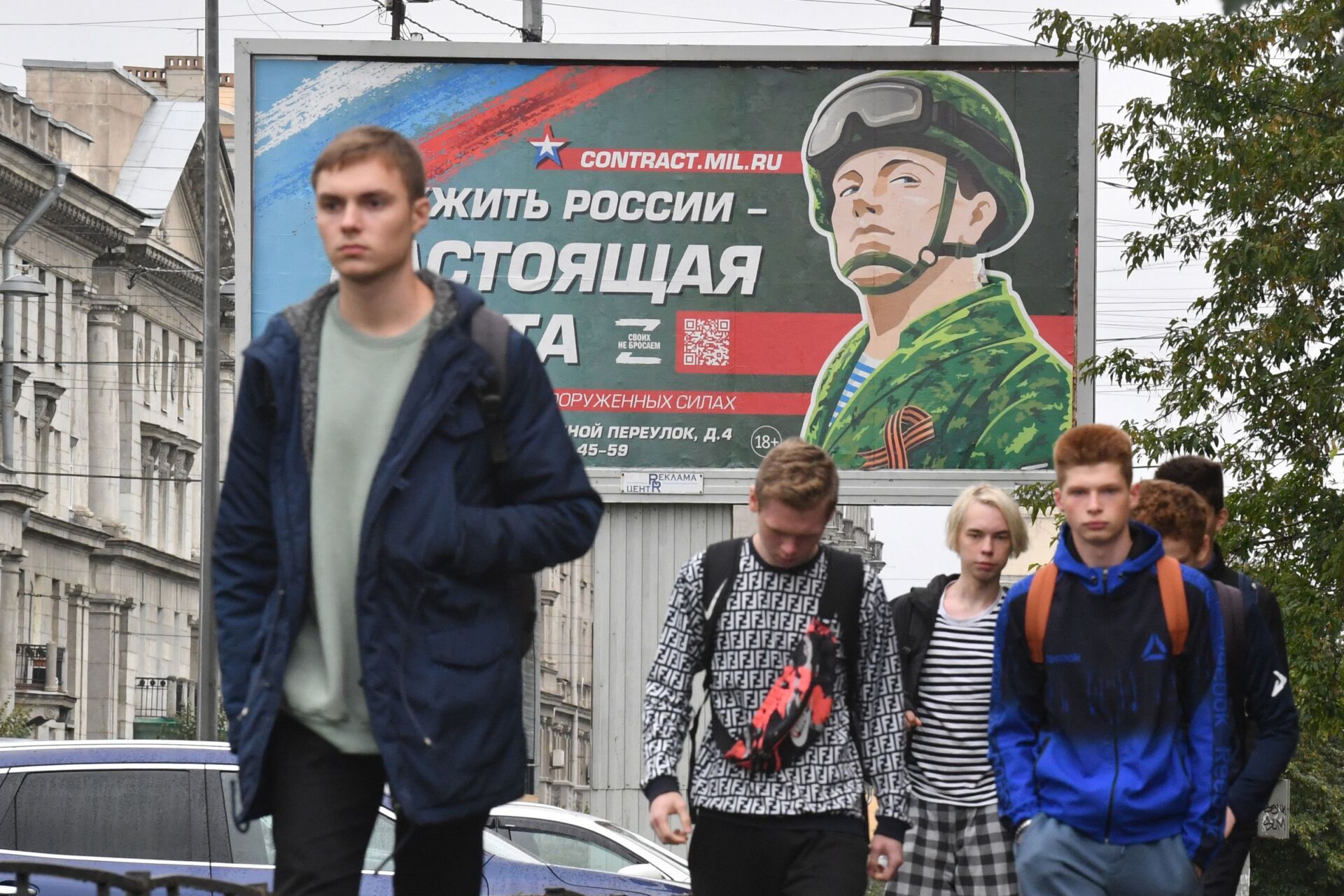
The problem with it is twofold. First, every state narrative is, at least in part, hypocritical. In this case, one can look at who is being mobilised: poor people from the periphery, but not the residents of Moscow, St Petersburg, or other big cities. The burden is on those who want to profit from this war through higher salaries. Second, there is a paradox. The Russian public opinion holds the military, as an institution, in very high regard, second only to the president. Yet nobody is willing to serve unless very well compensated. There is a lot of hypocrisy here as well.
In this context, too, one must be extremely cautious not to oversimplify or paint a caricature of Russian society, as it is not a solid profile. It is rather what Max Weber defined as an ‘ideal type’. We must not project our own ideas onto Russians.
Putin tries to avoid declaring another mobilisation, thus recruiting from everywhere in the world—but not in Russia. He is only constrained by his ability to pay soldiers. For the first time, the Russian people see an opportunity for social mobility through this war. They see it as a chance to upgrade their lives—again, a hypocrisy.
So far, it appears that strategic communication efforts by Ukraine and its partners—which try to highlight that the Russian forces have not been as glorious as the Kremlin TV portrays them—have failed to influence Russian society. How do we design an effective messaging campaign that will resonate with the Russian militarised culture and society?
These efforts have failed because it is a war of propaganda as well. Russia is quite strong in this field of warfare and can block all this messaging through increasingly severe censorship. As a direct result of this war, the system has also become more autocratic and more militarised.
One might wonder whether the west needs to go on the offensive to further influence Russia. I do not think that we, Europeans, need offensive operations in the field of propaganda, but instead lead by example. For instance, I believe that we have a superior political system, and beginning to doubt it ourselves can be more problematic than the Russian attempts to undermine it.
This is a little bit of critique against what is happening now on the other side of the Atlantic. We must abide by national and international law. We must be serious about our own democratic rules and values. It is by defending these core principles that we stand strong. Offensive propaganda, on the other hand, is not always the correct approach, as it is prone to exaggeration, whereas we must remain strictly factual.
Russia has been losing many of the advantages it enjoyed, such as economic resilience and manpower superiority. Given what we know about its strategic culture, do these setbacks make Russia more or less dangerous?
Defeated or victorious, Russia will remain a problem, especially to the Baltic region. We say that we must win this war, and it is clearly true. But this will not be the end. How will Russia respond to losing? What will an internally unstable Russia mean for us? The tragedy is that Russia has already taken this path. Likewise, if Russia manages to win—that is, to impose its will on Ukraine, it will continue to pose a threat to Europe. So, we are stuck for a long time.
Russia has a long tradition of destroying itself. It takes risks, it loses, and it endures.
I do not adhere to a so-called ‘stepping stone theory’, which suggests that once Russia is ‘done’ with Ukraine, it will go after the Baltic states, and so on and so forth. That is not to imply that there are no such intentions in the Kremlin; this scenario certainly exists. But it is a huge step from having an idea to applying it. In the short term, it would take a visible buildup in the Western Military District, planning, infrastructure, and manning.
In the meantime, the only response we have is to be ready ourselves. We have no impact on what the Russians do or who they are. Nor is it necessary. Russia has a long tradition of destroying itself, as well as a very strong ‘self-destructive’ feature in its character. It takes risks, it loses, and it endures. It is never nice.
We have discussed Russia’s key vulnerabilities. Yet, what is our main weakness?
We, western and northern European countries, still live in vacation mode, admittedly more so in parts of western Europe than in the north. We still believe that things will turn for the better and that we will return to normal as soon as the war in Ukraine is over, which is not the case. It applies not only to our relationship with Russia but also with China and the United States—the turmoil is much broader.
Our main weakness is that we do not believe in ourselves. Let me give an example, not as a direct comparison, but as a symbolic illustration. In 2019, Notre-Dame de Paris caught fire and burned down, and major newspapers ran headlines suggesting that “This is the end of Western Civilisation.” Yet President Macron said that France would rebuild the cathedral in five years, no matter the cost. And they did it. So, we are able to do anything if we believe in it, and if we put our money where our priorities are. This is why the Ukrainians keep fighting—because our way of life is worth defending. Unless we are convinced of this ideal, we are doomed.
This article was written for ICDS Diplomaatia magazine. Views expressed in ICDS publications are those of the author(s).