Anders Wivel
Professor of International Relations, Department of Political Science, University of Copenhagen
Following the Russian full-scale invasion of Ukraine in 2022 and the election of Donald Trump to a second presidential term in 2024, Denmark has transformed its security posture from super-Atlanticism to European hawkishness. Remaining a staunch supporter of the liberal international order and a close ally of the United States, Denmark now sees strong territorial defence and close cooperation with European partners as important tools for national security.
For most of the post-Cold War period, Denmark viewed the US as the most important guarantor of a rules-based and liberal international order. As a small state, Denmark has an interest in strong international institutions that provide shelter against economic, military, and societal challenges, promote transparency, secure the voices of weaker actors, and enable the punishment of great powers that break the rules. A regulated global market has served Denmark’s small open economy and competitive private sector well by providing opportunities for economic growth. Furthermore, a liberal international order is seen as mirroring Danish welfare state values and advancing liberal democracy and human and social rights.
Although Denmark never agreed substantially with the US on all issues (e.g., climate and gender policy), the American superpower was viewed as both willing and able to maintain and develop an international society characterised by strong international institutions, sovereign equality, and the promotion of liberal democracy and market economy. Consequently, Denmark supported a US-led international order, viewed as a bulwark against alternative agendas promoted by Russia and China.
With the election of Donald Trump as US President in 2016 and, in particular, since the start of the second Trump Presidency in 2025, the US is no longer seen as willing and able to uphold the rules-based liberal international order. The Trump administration openly advocates a world divided into spheres of influence dominated by great powers, prefers tariffs to free trade, and evaluates other states by their usefulness to US interests rather than their democratic pedigree.[1] Denmark continues to work with the US when possible, but has shifted its diplomatic focus towards actors in American society that support (at least parts of) a liberal rules-based international order and/or can influence US foreign policy in this direction. At the same time, Denmark has pursued a more independent position in international security. Consistently one of the strongest supporters of Ukraine since Russia’s 2022 full-scale invasion, Denmark has emphasised both interest-based (helping Ukraine deter Russia from attacking EU and NATO member states) and normative arguments (assisting Ukraine to uphold international law). In doing so, Denmark has sought status as a ‘good citizen’ actively contributing to the international and European security order.
Danish security and defence policy since the early Cold War has been characterised by seeking shelter from external threats through NATO membership and bilateral relations with the US.[2] Denmark was a founding member of NATO in 1949, which was seen as a pragmatic solution to its security challenges, after attempts to forge a Scandinavian Defence Union with Sweden and Norway proved unsuccessful. During the Cold War, Denmark was considered an ‘ally with reservations’ or even ‘quasi-neutral’ due to its modest defence budget, its Nordic security identity, and its scepticism towards US deterrence policy.[3] Still, Denmark complied with US preferences when necessary, for example, by allowing a continuous US military base presence in Greenland since 1951 and accepting West German rearmament from 1955.[4]
After the end of the Cold War, Danish support for the liberal international order translated into a close partnership with the US in security and defence policy. Denmark was an ally and participant in the US-led wars in Kosovo, Afghanistan, and Iraq, openly endorsing the US position on Iraq in opposition to big EU member states Germany and France prior to the invasion in 2003.[5] From 2004, Denmark transformed its armed forces from territorial defence to expeditionary forces (including the abolition of ground-based air defence and phasing out submarines) with the rationale that there was no expectation of a territorial threat in the short- to mid-term future and resources were better spent on supporting US-led interventions solidifying and expanding the liberal international order.
Danish policymakers viewed the European post-Cold War security order as ‘a unique window of opportunity’, allowing a small state to pursue so-called ‘active internationalism’: a foreign and security policy seeking actively to advance Danish interests and values internationally, even when this could be costly or lead to disagreement with great powers.[6] Likewise, the UN and Nordic cooperation were viewed as arenas for collective action and value promotion, while having limited importance for Danish national security. In security and defence policy, Denmark remained a ‘super-Atlanticist’ pursuing “a strong and seemingly unwavering support for the American world order as well as specific US policies that goes beyond the policies of their peers and seek to foster a ‘special relationship’ between the small ally and the US superpower.”[7]
Russia’s full-scale invasion of Ukraine in combination with Donald Trump’s second presidency have changed assessments and expectations on how best to pursue Danish security interests. The Russian invasion of Ukraine reintroduced a short-term territorial military threat to EU and NATO member states. US foreign policy in the second Trump presidency showed that this threat would not necessarily be deterred or countered by the Americans. In addition, the Trump administration’s intention to take over Greenland in 2025 and 2026 challenged Danish policymakers’ perception of a special relationship between Copenhagen and Washington built on Danish super-Atlanticism and military contributions to US-led military operations.
Consequently, policymakers assess that the US is now a less reliable provider of European security than before and may even threaten the territorial integrity of the Kingdom of Denmark (Denmark, Greenland, and the Faroe Islands). While continuing to stress the importance of the US as an important ally, Danish policymakers now seek a broader palette of complementary and overlapping solutions to national security, including increasing support for stronger European and Nordic-Baltic cooperation on security and defence.[8]
This shift in security priorities entails what might be termed a dependency-abandonment dilemma for Denmark. As a European NATO member and, until recently, a super-Atlanticist small state, Denmark is deeply dependent on the US as a security provider, but as the US has become less reliable, Denmark needs to diversify and seek security shelter from elsewhere. However, doing so is likely to affect US security provision. If Denmark were to scale down security cooperation with the US or signal reluctance to military acquisitions from American arms exporters, this is likely to be seen as a provocation by the US administration, making Denmark less ‘worthy’ of protection. If Denmark were to go all-in on alternative solutions, this may be interpreted by the administration as Denmark being less ‘needy’ of protection. In sum, Denmark faces a dilemma: seeking alternatives to the US as its most important ally (necessary because the US has become less reliable) while securing continued US security provision and avoiding abandonment (necessary because dependence persists).
In an effort to adapt to changes in its security environment, Denmark has seen two major shifts in its security and defence policy since 2022.
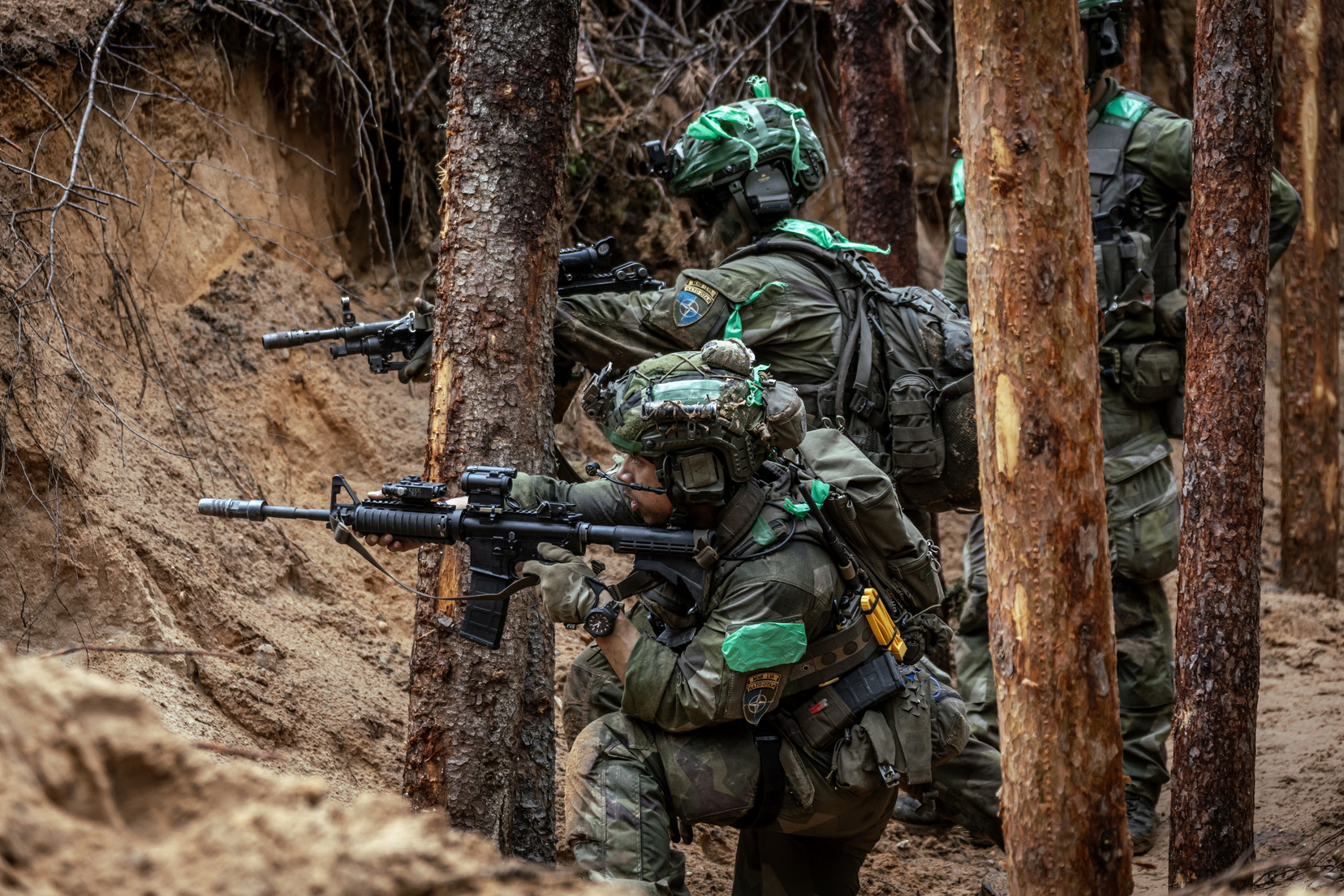
First, Denmark has embarked on a massive rearmament and reorganisation of the armed forces to rebuild territorial defence. In 2015, Danish defence expenditures hit a low of 1.2% of GDP; in 2024, they reached 2.4%, and in 2026, they are expected to reach 3.5%.[9] This has been accompanied by mandatory conscription for both men and women, a projected 50% increase in conscripts, and massive defence acquisitions, including the re-establishment of ground-based air defence, 16 additional F35 stealth strike fighters (bringing the fleet to a projected 43 fighters), and a significant buildup in artillery, surveillance, and drone capacities.
Second, Denmark has diversified its search for security shelter. In 2022, Denmark abolished its opt-out from EU security and defence cooperation, allowing it to participate in EU military missions and operations, as well as in the Permanent Structured Cooperation (PESCO), and join the European Defence Agency (EDA).[10] Denmark’s top priority during its 2025 EU Presidency was European security and defence.[11] Also, Denmark—for many years the least Nordic of the Nordic countries in security and defence policy—has rekindled relations with its neighbours through NORDEFCO (with a focus on Ukraine and the Arctic) and benefited from European and Nordic support in the crisis over Greenland. In the Baltic Sea area, Denmark has taken leadership of Multinational Division North, NATO’s divisional headquarters in Latvia, actively supporting Baltic defence planning, personnel training, and coordination and contributed to NATO’s enhanced Forward Presence in Estonia.[12] Effectively, Denmark is now a European defence and security hawk emphasising the importance of European armament and deterrence, preferably with the US.
Despite these changes, Denmark’s security relations with the US remain vital. Copenhagen has consistently worked to de-escalate by seeking a new and revised base and security agreement between Greenland, Denmark, and the US. The Danish embassy in Washington works actively to communicate shared interests and values and to secure bipartisan understanding of Danish concerns in the US Congress. In 2025, by ratifying a base agreement with the US, the Danish parliament decided to give up more than 70 years of resistance against foreign bases and troops on Danish territory in peacetime and, effectively, moved towards closer cooperation and potentially deeper dependence on the US. In sum, while Denmark may no longer be a super-Atlanticist, it is still an Atlanticist country determined to maintain a strong transatlantic relationship.
There are no easy solutions to the Danish security challenges. A strong economy allows Denmark to continue arming and supporting Ukraine, while institutional choices are less straightforward. In the future, Denmark should strike a balance between Atlanticism and European hawkishness by working for:
[1] For an elaboration on the Chinese, Russian, and US challenges to the liberal and rules-based international order and Denmark, see: Chapter 2 in Byrjalsen, Kristensen, and Wivel, Forsvar, sikkerhed, og demokratisk kontrol [Defence, security, and democratic control] (Aarhus Universitetsforlag, 2026 forthcoming).
[2] On small-state shelter-seeking, see: Thorhallsson and Steinsson, “A theory of shelter: Small-state behaviour in international relations,” in Agency, Security and Governance of Small States (Routledge, 2023), 29-48.
[3] P. Villaume, Allieret med forbehold. Danmark, NATO og den kolde krig. En studie i dansk sikkerhedspolitik 1949–1961 [Allied with Reservations. Denmark, NATO and the Cold War. A Study in Danish Security Policy 1949–1961] (Eirene, 1995); C. Holbraad, Danish neutrality: a study in the foreign policy of a small state (Oxford University Press, 1991).
[4] For a historical overview and discussion of Danish security and defence policy, see: Wivel, “In War and Peace: Security and Defence Policy in a Small State,” in The Oxford Handbook of Danish Politics (Oxford University Press, 2020), 453-469.
[5] Mariager and Wivel, “Denmark at war: great power politics and domestic action space in the cases of Kosovo, Afghanistan and Iraq,” in Danish Foreign Policy Review 2019 (Danish Institute for International Studies, 2019), 48-73.
[6] Holm, “Danish foreign policy activism: The rise and decline,” in Danish Foreign Policy Yearbook 2002 (Danish Institute for International Studies,2002), 21-23.
[7] Wivel and Crandall, “Punching above their weight, but why? Explaining Denmark and Estonia in the transatlantic relationship,” Journal of transatlantic studies 17(3) (2019): 392-393.
[8] See: Danish Prime Minister’s Office, ”Styrket forsvar af Europa i fokus under nordisk-baltisk topmøde i Tallinn [Strengthened defence of Europe in focus during Nordic‑Baltic summit in Tallinn],” 9 June 2026.
[9] Danish Ministry of Defence, ”Økonomisk plan: Regeringen øger forsvarsudgifterne markant allerede fra 2026 [Economic plan: The government is significantly increasing defence spending already from 2026],” 24 February 2026.
[10] Danish Ministry of Defence, “Denmark and the EU,” n/d.
[11] European Council, ”Program for det danske EU-formandskab,” European Council, n/d.
[12] Danish Defence, “Latvia – securing the eastern flank of NATO,” Danish Defence, n/d; Danish Defence, “Estonia – NATO Enhanced Forward Presence (eFP),” Danish Defence, n/d.
More on the brief series: Small States